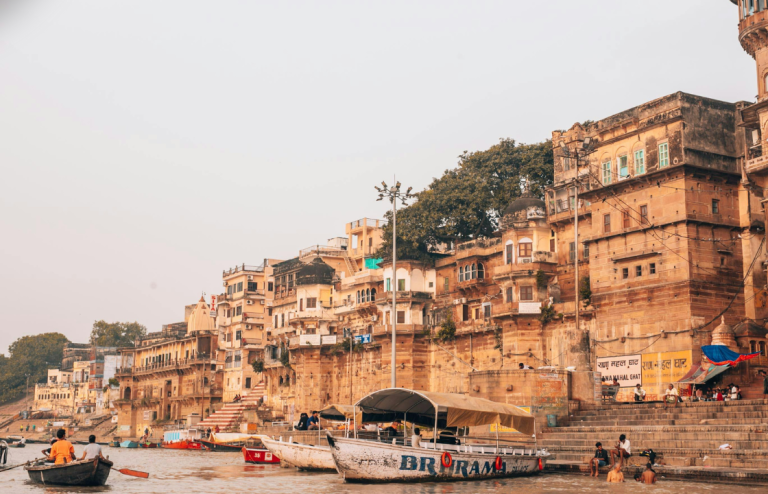
Shree Kashi Vishvanath Temple in Varanasi

Located on the western bank of the sacred Ganges River in Varanasi, the Kashi Vishwanath Temple stands as one of the revered 12 Jyotirlingas, dedicated to Lord Shiva. Revered as Vishwanatha or Vishweshwarar, symbolizing ‘the ruler of the universe’, the temple serves as a focal point for devotees, earning Varanasi the epithet of the city of Lord Shiva. Adorned with 800 kg of gold plating on its tower, this temple stands as a testament to the rich cultural heritage of India.
Entry into the temple complex entails adherence to strict guidelines, with cameras, mobile phones, and electronic devices prohibited and required to be deposited in lockers outside. Foreign visitors are directed to Gate number 2 for entry, allowing them to bypass the queue of Indian devotees. Within the complex lies the Jnana Vapi, or wisdom well, accessible exclusively to Hindu worshippers.
Traditionally, on significant festivals such as Shivaratri, the temple witnesses the solemn visit of the Kashi Naresh, the king of Kashi, who performs worship rituals within the temple premises, barring entry to others until his prayers conclude. The sanctity of the Kashi Vishwanath Temple is further underscored by its mention in various Hindu scriptures.
Externally, the temple boasts intricate carvings that exude a divine aura, adding to its spiritual allure. Additionally, the temple houses various smaller shrines dedicated to deities such as Kaalbhairav, Vishnu, Virupaksh Gauri, Vinayaka, and Avimukteshwara, contributing to its significance as a sacred pilgrimage site.

History of Kashi Vishwanath Temple
The history of the Kashi Vishwanath Temple traces back to ancient times, with its earliest references found in the Puranas, notably the Kashi Khanda of the Skanda Purana. Throughout its existence, the temple has endured destruction and reconstruction on multiple occasions.
The first recorded demolition occurred in 1194 when Qutb-ud-din Aibak’s army razed it to the ground during their conquest after defeating the King of Kannauj. Subsequently, the temple was reconstructed under the patronage of Delhi’s Iltutmish, only to face destruction once more during the reign of Sikander Lodhi. Raja Man Singh undertook its rebuilding during the Mughal Emperor Akbar’s era.
However, in 1669 CE, Emperor Aurangzeb ordered the temple’s demolition, replacing it with the Gyanvapi Mosque. Eventually, in 1780, Maharani Ahilyabai Holkar of Indore, a Maratha monarch, oversaw the temple’s final reconstruction. Renowned as the Golden Temple dedicated to Lord Shiva, it features two golden-domed structures, with the gold donated by Sikh Maharaja Ranjit Singh and silver contributed by the Bhosales of Nagpur.
Since January 28, 1983, the temple has been under the ownership of the Uttar Pradesh government, initially managed by Dr. Vibhuti Narayan Singh and later by the Kashi Naresh, continuing to serve as a revered center of worship and pilgrimage.
Significance in Hinduism
The Kashi Vishwanath Temple stands as a revered sanctuary within Hinduism, holding profound spiritual significance. It is widely believed that undertaking a pilgrimage to this hallowed site absolves one of sins and paves the path to salvation, known as moksha. Devotees flock from distant places to offer their prayers and seek blessings from Lord Shiva.
Integral to the Char Dham Yatra, which encompasses four sacred pilgrimage destinations across India, the Kashi Vishwanath Temple holds a distinguished place alongside Badrinath, Dwarka, and Puri. Pilgrims endeavor to visit all four dhams as part of their spiritual journey, aspiring for ultimate spiritual fulfillment.
Architecture of Kashi Vishwanath Temple
The Kashi Vishwanath Temple exemplifies the Nagara style of temple architecture, renowned for its towering spire (shikhara) and elaborate stone carvings. Within its complex, a harmonious fusion of architectural elements can be observed, with primary reverence paid to Lord Shiva, the temple’s principal deity. At the heart of the temple lies the sanctum sanctorum, enshrining the revered Jyotirlinga of Lord Vishwanath.
The exterior of the temple is adorned with intricate carvings, depicting a myriad of scenes from Hindu mythology, celestial beings, and delicate floral patterns. These elaborate artworks serve as a tribute to the skill and craftsmanship of ancient Indian artisans, showcasing their mastery in stone carving and architectural design.
Legends
The Kashi Vishwanath Temple in Varanasi is rich with mythology and legends that deepen its spiritual allure. Central to these tales is the presence of Lord Shiva, also known as Vishwanath or Vishveshvara, who is believed to have manifested in Varanasi, blessing the city with sanctity and offering the path to salvation. Among the prominent legends is the establishment of the Jyotirlinga by Lord Vishwanath himself, making it one of the twelve sacred Jyotirlingas in India. Kaal Bhairav, the guardian deity of Varanasi, ensures the purity of intentions among visitors, while the goddess Annapurna’s tale highlights the city’s significance in providing sustenance. Additionally, the temple’s history intertwines with the narrative of King Harishchandra and the reconstruction efforts led by Queen Ahilyabai Holkar of Indore in the 18th century. Varanasi’s eternal connection to Lord Shiva and its association with the Ganges River further enhance its divine stature, earning it the title of the “City of Lord Shiva.”
Challenges and Controversies
The Kashi Vishwanath Temple has encountered several challenges and controversies over its extensive history. Among these are religious conflicts stemming from the presence of the Gyanvapi Mosque nearby, resulting in ongoing legal disputes between Hindu devotees seeking the temple’s complete reclamation and Muslim groups opposing changes. Environmental concerns arise due to the temple’s location in a flood-prone area, with rising Ganges River levels threatening its structural stability, prompting ongoing conservation efforts. Additionally, crowd management remains a pressing issue due to the significant influx of pilgrims and tourists, necessitating improvements in infrastructure and security measures to enhance the visitor experience.
Conclusion
The Kashi Vishwanath Temple in Varanasi serves as a testament to India’s enduring faith and cultural legacy. Despite facing destruction and reconstruction throughout its history, the temple remains a beacon of devotion for worshippers across generations. It continues to inspire pilgrims, scholars, and artists, embodying India’s spiritual and cultural heritage. As it adapts to modern challenges, the temple symbolizes the timeless bond between humanity and the divine, attracting people from diverse backgrounds in search of solace, enlightenment, and salvation amidst the vibrant tapestry of Varanasi.
How To Reach Kashi Vishwanath Mandir
By Flight:
- Varanasi has an international airport, although direct international flights are limited.
- Most domestic airlines operate regular flights to and from Varanasi.
- Jet Airways, Air India, and Spice Jet offer the most frequent flights.
- Nearest Airport: Varanasi
By Road:
- Road connections to Varanasi are well-maintained and convenient.
- Many tourists traveling to Uttar Pradesh combine visits to nearby cities and commute between them by road.
- Nearby cities like Allahabad, Kanpur, and Gorakhpur are within driving distance.
- National Highway 19 serves as the main connecting road.
By Train:
- Varanasi is a major railway station serving trains passing through northern India.
- Almost all trains passing through this region stop at Varanasi.
- Mughal Sarai Junction, 18 kilometers away from the main city, is another major station with trains from cities across India.
Local Transport:
- Cycle rickshaws and auto rickshaws are available for travel within Varanasi.
- Mini buses operate within the city for local transportation.
- Boats are used for tours along the River Ganga, offering a unique perspective of Varanasi’s landscape.
Which month is good to visit Kashi Vishwanath Temple?
The optimal time to visit the Kashi Vishwanath Temple is during the winter months, spanning from November to February. This period offers pleasant and comfortable weather conditions, ideal for exploring the temple and its surroundings. Conversely, Varanasi experiences extreme heat during the summer months, which can make it uncomfortable for visitors to fully enjoy their experience at the temple. Therefore, winter serves as the preferred season for pilgrims and tourists to plan their visit to this revered spiritual site.
Why Kashi Vishwanath temple is famous?
The Kashi Vishwanath Temple is renowned as one of the most prominent Hindu temples venerating Lord Shiva. Situated in Varanasi, Uttar Pradesh, India, it holds a significant place in Hindu religious beliefs. Positioned on the western bank of the sacred Ganges River, the temple is revered as one of the twelve Jyotirlingas, which are considered the most sanctified shrines dedicated to Lord Shiva.
What is the cost of Darshan in Kashi Vishwanath?
| Darshan/Aarti | Timing | Price (INR) |
| Sugam Darshan | 6:00 A.M. to 6:00 P.M. | 300 |
| Mangla Aarti | Normal Days: 3:00 A.M. to 4:00 A.M. | 350 |
| Bhog/Aarti | 11:15 A.M. to 12:20 P.M. | 180 |
| Saptirishi Aarti | 7:00 P.M. to 8:15 P.M. | 180 |
How to touch Kashi Vishwanath Temple?
The temple authorities have implemented a new requirement for devotees wishing to have direct contact with the Jyotirlinga, known as sparsh darshan, within the sanctum sanctorum. Henceforth, devotees are required to wear traditional attire, specifically Dhoti-Kurta, as part of the protocol.
5 star hotels near kashi vishwanath temple
BrijRama Palace, Varanasi By the Ganges
- Address-Darbhanga Ghat, Dashashwamedh, Uttar Pradesh 221001
- Phnone-070840 07007
- Check-in time: 14:00
- Check-out time: 12:00
| Health and Safety | Amenities | Services |
| Enhanced Cleaning | Popular Amenities | Front Desk |
| Commercial-grade disinfectant used to clean the property | Spa | 24-hour |
| Employees wear masks, face shields, and/or gloves | Breakfast (free) | Full-service laundry |
| Enhanced cleaning of common areas | Wi-Fi (free) | |
| Personal Protection | Services | Parking & Transport |
| Masks and/or gloves available for guests | Front desk | Airport shuttle (extra charge) |
| Physical Distancing | Car rental onsite | |
| Physical distancing required | Rooms | Local shuttle |
| Common areas arranged to maintain physical distancing | Air conditioning | |
| Safety dividers at front desk and other locations | Food and Drink | Children |
| Minimized Contact | Restaurant | Child-friendly |
| No-contact check-in and check-out | Room service | |
| Buffer maintained between room bookings | Breakfast (free) | Wellness |
| Increased Food Safety | Spa | |
| Individually packaged meals | ||
| Health and Safety Measures are provided by the hotel. Contact the hotel for more details. | Pets | |
| No pet |
Hotel Divine Destination
- Address-D47, Taxi Stand, 196, Laksh Road, opposite Mazda, Ramapura Luxa, Varanasi, Uttar Pradesh 221001
- Phone -0542 245 0246
- Check-in time: 12:00
- Check-out time: 11:00
| Amenities | |||
| Popular Amenities | Parking & Transport | Rooms | Services |
| Parking | Parking (free) | Air conditioning | Front desk |
| Breakfast | Self parking (free) | Kitchen in some rooms | 24-hour |
| Wi-Fi | Valet parking (free) | Refrigerator | Full-service laundry |
| Air conditioning | EV charger (free) | Coffee maker | |
| Internet | Airport shuttle (extra charge) | ||
| Wi-Fi in public areas | Car rental onsite | ||
| Public Internet workstation | Local shuttle | ||
| Activities | Food and Drink | Pools | |
| Boutique shopping | Restaurant | No pools | |
| Children | Room service | No hot tub | |
| Child-friendly | Breakfast (free) | ||
| Rooms | Services | Wellness | |
| Air conditioning | Front desk | No fitness centre | |
| Kitchen in some rooms | 24-hour | No spa | |
| Refrigerator | Full-service laundry | ||
| Coffee maker | |||
| Pets | Bathrooms | ||
| No pets | Private bathroom | ||
| Shower |